
Zeeland Mussels and Moules-Frites: The Story of Belgium’s National Ritual
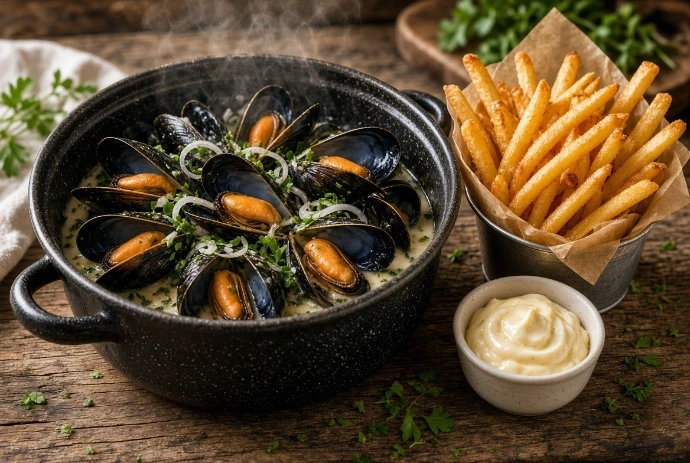
Some dishes tell you more about a country than a history book does. In Belgium, this one arrives at the table in a black pot, lid still steaming, with a portion of fresh fries beside it and a bowl of mayonnaise. The lid comes off, the steam rises, and for three seconds nobody says a word. Moules-frites is not a recipe — it is a ritual. And it begins a hundred kilometres from here, in the cold water of the Oosterschelde.
Our five preparations
Chef Adrien Schurgers and his brigade serve five traditional preparations, as Belgian as they come. Every pot is cooked to order over a high flame, covered: the mussels open in a few minutes in their own seawater.
• Marinière — the benchmark. Celery, onion, a knob of butter, cracked pepper, nothing else. The broth left at the bottom is the real test of a mussel kitchen.
• White wine — a sharper register: the wine deglazes the cooking juices and produces a lively broth, for anyone who finds marinière too well-behaved.
• Garlic cream — the generous one. Cream, confit garlic and reduced cooking liquor make a sauce a chip dives into without hesitation.
• White wine & Garlic cream — The best of both worlds. The freshness of a white-wine deglaze, followed by the roundness of confit-garlic cream. A full, generous broth for sauce lovers.
• Tarragon cream — our autumn favourite. Tarragon brings an aniseed note that lightens the cream and lifts the mussel without ever masking it.
The ritual: use your first empty shell as tongs to pick out the next mussel. Save the broth for last. And any mussel still shut after cooking simply goes to one side.
Zeeland: the North Sea’s kitchen garden
In Yerseke, a small port on the Oosterschelde estuary in the Dutch province of Zeeland, mussels are not caught. They are farmed. Seed mussels are sown on leased plots on the seabed, where they grow slowly for two to three years with the rhythm of the tides. This bottom-culture method — no ropes, no poles — produces a mussel with a thick shell and firm, meaty flesh, shaped by the brackish water of the Scheldt.
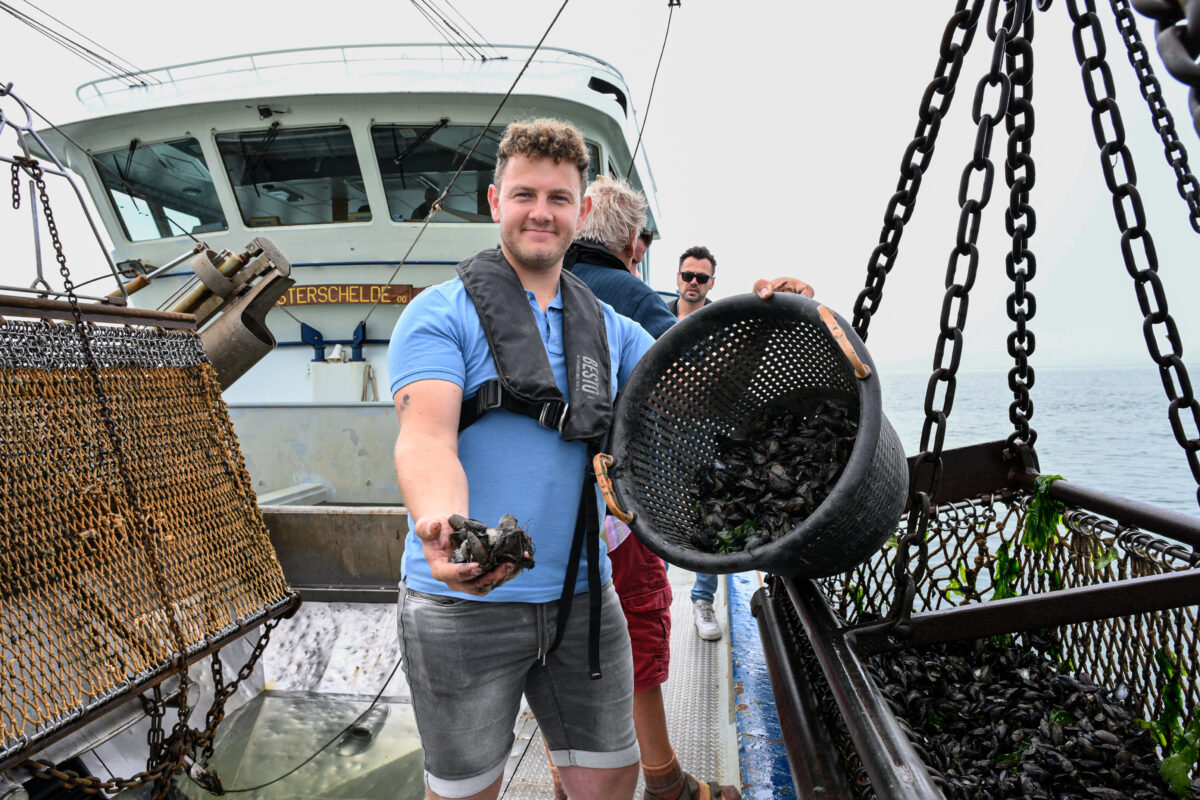
Before they are sold, the mussels spend a few days in clear running water to purge the last of their sand. You cannot see that step on the plate, but you can taste it. It is the difference between a mussel that grits between the teeth and one you actually enjoy.
The season traditionally opens in summer and runs into spring. The old rule about “months with an R” — September to April — matters far less now that refrigeration exists, but it still holds true on one point: autumn is when the Zeeland mussel is at its plumpest and most flavourful. September, October and November are its three great months.
How Brussels made the mussel its own
Brussels has no coastline. What it had was better: a canal. Dug in the sixteenth century to link the city to the river Rupel and onward to the Scheldt, the Willebroek canal put the port of Antwerp — and Zeeland behind it — within a barge journey of the capital. Fish and shellfish travelled straight into the centre, to the fish market whose memory survives in the Quai aux Briques and the Sainte-Catherine quarter.
There, the mussel was the shellfish of ordinary people: cheap, sold by the measure, cooked in estaminets and street stalls. Its marriage to the fried potato took hold in the nineteenth century, when the travelling friture became an urban trade in its own right. The exact origin of the chip is still argued over — the Meuse valley and Paris both claim it — but the pairing itself became unmistakably Belgian. It was not invented in a chef’s kitchen. It was born in the street, and only afterwards came indoors.
The fries: the other half of the dish
No mussel is saved by a limp chip. Ours are fresh and fried twice.
• Second fry, hotter, just before the plate leaves the pass: the crust forms — golden and brittle — while the inside stays soft.
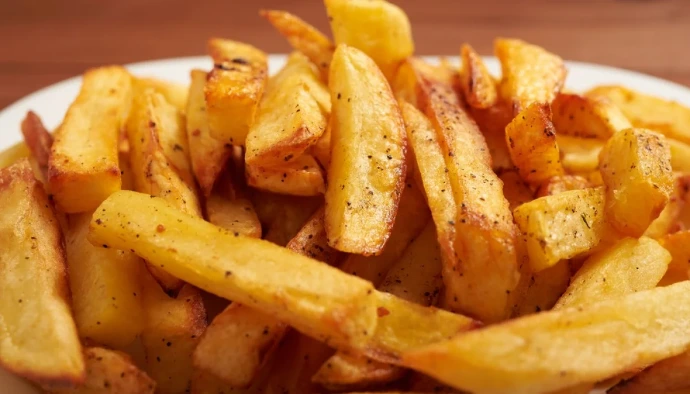
Both baths are in beef tallow, as in the country’s best fritures. That is what gives the round, faintly nutty flavour no vegetable oil reproduces. Alongside comes our own mayonnaise, made in-house with mustard: thick enough for a chip to stand upright in it.
What to drink
With marinière, a fresh, faintly tart Belgian witbier remains the most local pairing there is. A dry tripel stands up well to the garlic cream. With tarragon, a crisp dry white — Chablis, Muscadet, Sancerre — works beautifully. Our wine list and our Belgian beer list will do the rest; ask the dining room, it is exactly the kind of question we enjoy.
Moules-frites in Watermael-Boitsfort, since 1683
Au Repos des Chasseurs — “the hunters’ rest” — earned its name honestly: this is where hunters stopped on the edge of the Sonian Forest in the seventeenth century. Three and a half centuries later the house plays the same part: a brasserie where you stop after a walk in the forest, bicycle leaning against the terrace, the whole family around one table.
Frequently asked questions
From Zeeland in the Netherlands, mainly from plots in the Oosterschelde estuary. They are bottom-cultured mussels, purged before dispatch, known for their firm and meaty texture.
Five : Marinière, white wine, garlic cream, tarragon cream, and white wine with garlic cream. All are served with our fresh fries, double-fried in beef fat, and our homemade mayonnaise.
From September to April, peaking in autumn — that is when the Zeeland mussel is at its fullest.
Strongly recommended at weekends and throughout the mussel season; essential from eight covers upwards.
Yes — a free private car park sits directly in front of the restaurant on Avenue Charle-Albert in Watermael-Boitsfort, one of the few restaurants in south-east Brussels where parking presents no difficulty, even for a group.
Yes. The brasserie welcomes families, the terrace seats 120, and five private rooms make group meals of up to 350 guests possible.