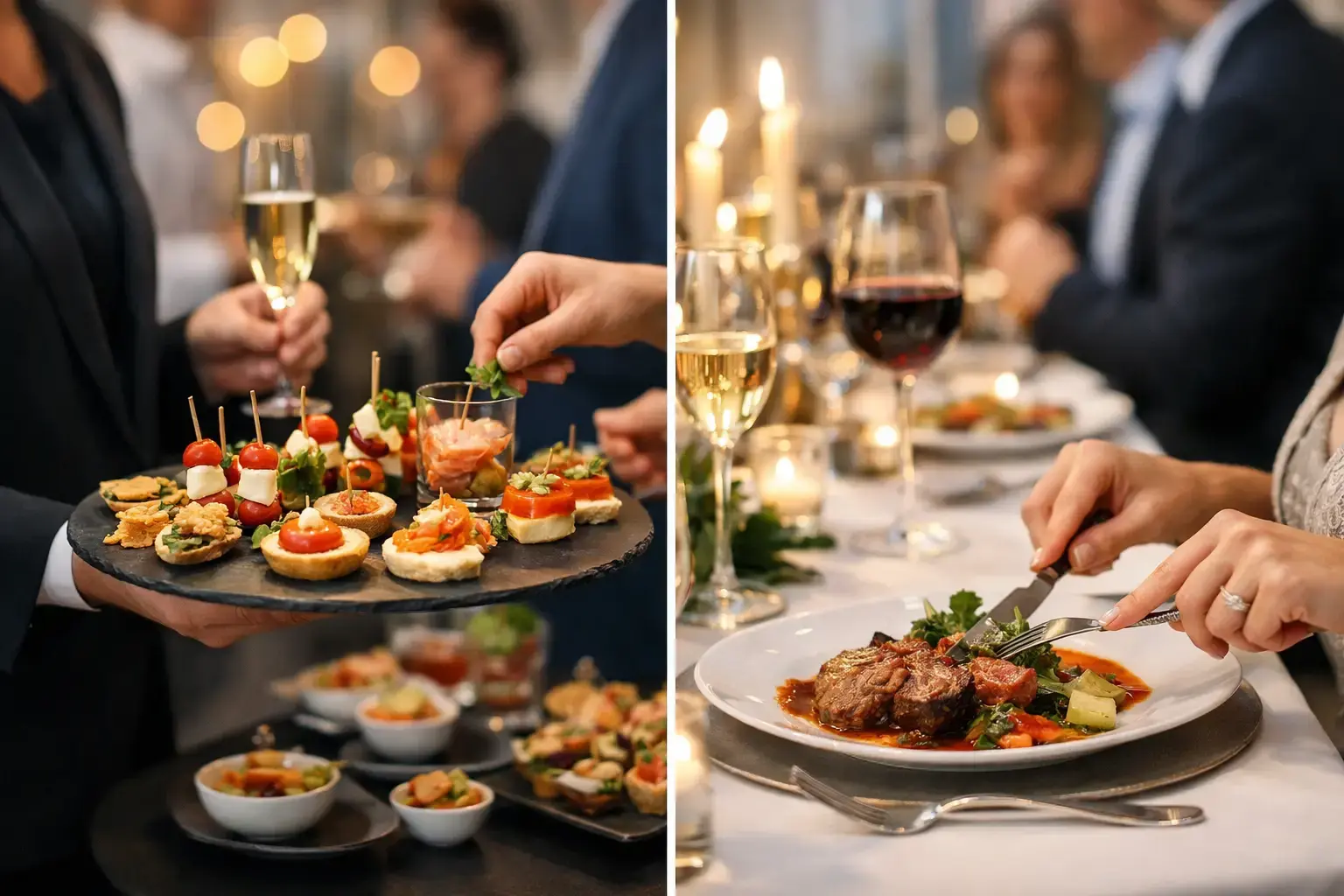
The decision is often made in just a few minutes — yet it shapes the entire reception. When hesitating between a standing cocktail and a seated dinner, you are not simply choosing a catering formula. You are defining an atmosphere, a flow through the space, a way of welcoming guests, and even the memory they will carry home from the evening.
For an elegant wedding, a milestone birthday, a private reception or a corporate event, there is no universal answer. The right choice depends on the number of guests, the time available, the level of formality desired, and the importance you place on conversation and movement. That is precisely what makes the question interesting: both formats can be remarkable, provided they are chosen for the right reasons.
Standing cocktail or seated dinner: a question of experience
A seated dinner immediately sets a frame. Guests take their places, the rhythm settles, the service structures the evening. It creates a feeling of comfort, generosity and continuity. This format is particularly suited to moments you wish to ritualise: a wedding with speeches, a multi-generational family celebration, a gala dinner, or a corporate evening where you want to offer guests a true parenthesis of prestige.
A standing cocktail produces a very different effect. It is more mobile, more lively, often more spontaneous. Guests meet more easily, move from one circle to another, and discover the reception at their own pace. This format appeals when you are looking for fluidity, a less formal kind of elegance, and a more conversational atmosphere. It naturally encourages mingling, which makes it a frequent choice for product launches, year-end gatherings, premium afterworks, and certain more contemporary wedding receptions.
The real question, then, is not which format is more refined. Both can be. The better question is: how do you want your guests to experience the time spent together?
When a seated dinner naturally imposes itself
A seated dinner reassures. It gives clear bearings to guests and offers a simple reading of the evening. Everyone knows where to sit, when dinner begins, and how the reception will unfold. For guests of varied generations, or for an event where comfort matters, this is a considerable advantage.
It also showcases the cuisine. Plated service allows for a more precise presentation, a carefully orchestrated succession of courses, and a more attentive tasting experience. When gastronomy occupies a central place in the event, this format gives it its full measure. Textures, temperatures, sauces and cooking points are appreciated more deeply when the meal unfolds in a deliberate sequence.
It is also a wise choice when there is a programme. Speeches, awards, musical performances, formal moments or professional interventions find their place more easily within an evening structured around a seated dinner. The framework is more readable, attention easier to capture.
That said, this format requires more precise logistics. The seating plan, service timing, dietary requirements and overall duration of the evening must all be anticipated with care. It is more solemn, sometimes less conducive to free movement. If your primary goal is to keep conversations flowing across the room, it is not always the most natural solution.
Events where a seated dinner shines
A seated dinner is often the best choice for a classic or elegant wedding, a confirmation, a milestone birthday, a year-end dinner, a family-reunion reception, or a corporate event where you wish to thank your guests with generosity. It also suits venues of character particularly well, where you want the décor, the service and the table to have time to truly exist.
Why the standing cocktail seduces so many hosts
The standing cocktail has gained considerable sophistication. It is no longer a secondary formula chosen by default. When properly conceived, it offers a refined, well-paced, distinctly contemporary experience. Bites follow one another, flavours vary, guests compose their own evening with greater freedom.
Its great strength remains conviviality. People talk more, move around, and discover several worlds within the same place. This dynamic is precious for events where not all guests know one another. Encounters happen more naturally than at a dinner where everyone tends to remain at their own table.
The standing cocktail also makes more flexible use of the space. A terrace, several lounges, a garden, a hall opening onto the outdoors, or different service points can enrich the experience. In a leafy, elegant setting, this formula often creates a sense of breathing room that guests deeply appreciate.
That said, its limitations should be acknowledged. Some guests, particularly older ones, may find a long evening on their feet less comfortable. Sufficient seating, leaning points and a truly fluid service must be planned. Another essential point: a standing cocktail must be generous. If it lacks abundance or rhythm, guests quickly feel they have not really dined.
What makes a great standing cocktail
Everything rests on balance. You need elegant bites, of course, but also substance. Cold and hot pieces, vegetal and richer creations, a controlled tempo, and a real progression toward something sweet. The quality of the service is decisive: trays must circulate naturally, without delay or overload, and any buffets must remain impeccable throughout the reception.
What makes a great standing cocktail
The number of guests matters, but it is not enough. A large gathering can be welcomed in either format if the venue allows. In practice, four criteria guide the choice more reliably.
The first is the purpose of the evening. If you want to encourage exchanges, movement and a certain elegant informality, the standing cocktail has the advantage. If you want to mark a moment, anchor a ceremonial dimension, or place a constructed menu at the heart of the experience, the seated dinner imposes itself more naturally.
The second is the profile of your guests. A guest list mixed in age, with families, elder relatives or international guests accustomed to more classic codes, will often appreciate the comfort of a seated dinner. A professional, urban audience, comfortable with receptions and drawn to a freer atmosphere, will readily embrace the standing cocktail.
The third is time. A standing cocktail allows a more flexible, often livelier format. A seated dinner takes longer but also offers more breathing space. If the reception is part of an already dense day, this consideration becomes decisive.
Finally, there is the effect you are seeking. A seated dinner conveys an impression of poised prestige. A standing cocktail projects a more contemporary, more relational, sometimes more creative image. Neither is superior to the other. Everything depends on the signature you wish to give your event.
And why not a hybrid format?
This is often the most balanced answer. Beginning with a cocktail to welcome guests, open conversations and let the venue play its part, then continuing with a shorter seated dinner, can combine the best of both approaches. Conversely, some private events benefit from a seated dinner followed by a freer lounge area for desserts, digestifs or a musical moment.
This hybrid formula is particularly compelling when you wish to combine refinement, rhythm and comfort. It gives the reception breadth without freezing it. In a venue capable of orchestrating several atmospheres with fluidity, the result can be remarkably harmonious.
In Brussels, in a setting like Au Repos des Chasseurs — between reception lounges, terrace and woodland atmosphere — this flexibility takes on its full meaning. The event is no longer reduced to a service at table. It becomes a journey, a succession of moments, each with its own intensity.
Hosting at Au Repos des Chasseurs: one setting, both formats
Founded in 1683 on the edge of the Sonian Forest, our house welcomes weddings, anniversaries, confirmations, seminars and corporate receptions in spaces designed to adapt to every format. Our reception lounges can accommodate up to 350 guests for a seated dinner, while our wooded terrace lends itself naturally to standing cocktails in the warmer months. Chef Adrien Schurgers signs a bistronomic cuisine that translates equally well into plated service or savoury and sweet pieces for buffet. For events spread over two days, eleven boutique hotel rooms allow your guests to extend the experience on site.
The right choice is the one that resembles your guests
We sometimes choose a format because it is fashionable, or because we have seen it work elsewhere. That is rarely the best starting point. A successful reception does not imitate. It corresponds to an occasion, a personality, a real and specific guest list.
If you imagine conversations crossing the room, glasses raised in late-afternoon light, a natural circulation between indoors and outdoors, the standing cocktail is probably the right language. If you dream of an elegant table, attentive service, a dinner that takes its time and puts each guest at ease, the seated dinner will better answer that promise.
The most beautiful choice is not the most spectacular. It is the one that makes the reception feel evident, fluid and generous to everyone who experiences it. When the format is right, elegance is not only visible on the plate or in the décor. It is read in the way each guest naturally feels in the right place.